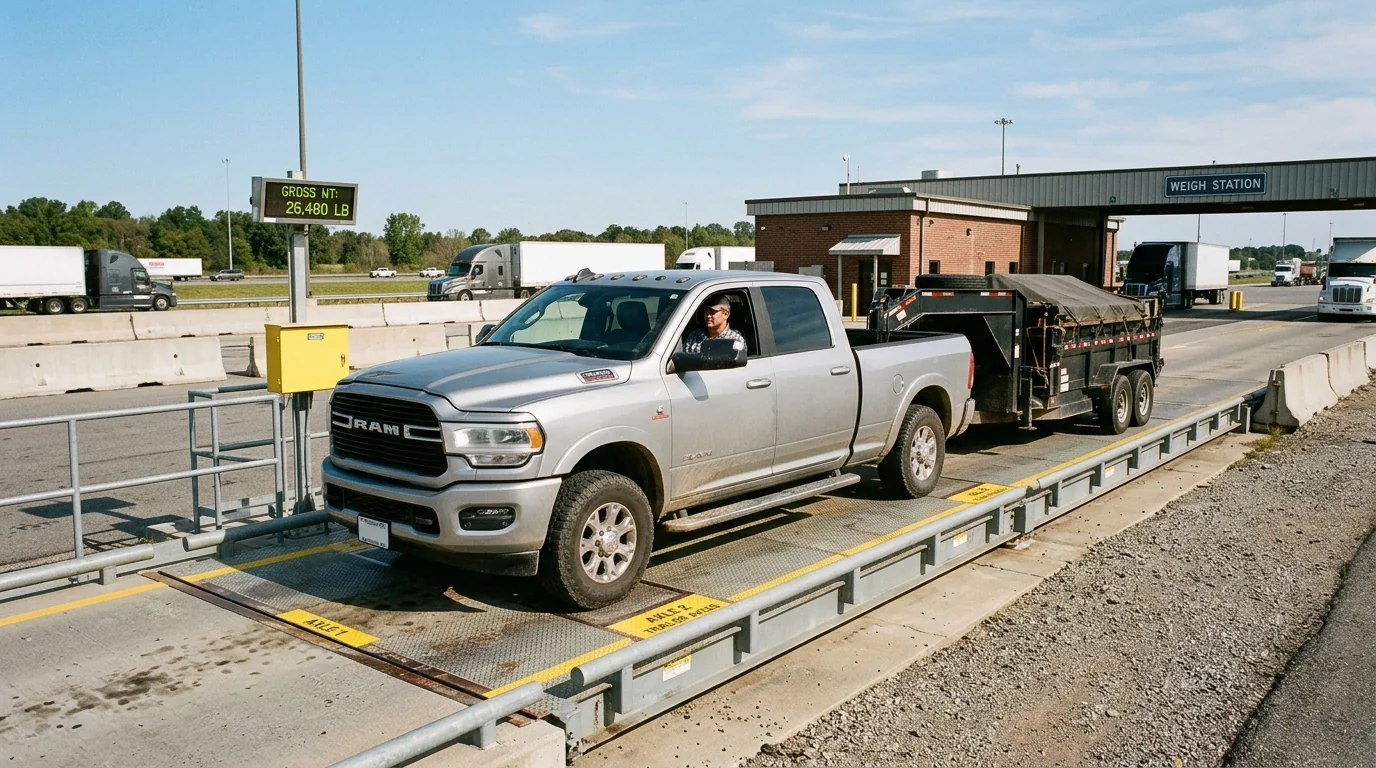
“Where can I find the weight of my truck?” has two useful answers: factory records help identify its original specification, while a vehicle scale measures the truck in its present condition. The number printed beside GVWR on the door label is a loading limit, so it cannot tell you what your pickup weighs today.
That distinction matters when you add a camper, carry materials, arrange vehicle transport, or check how much room remains for passengers and equipment. An empty bed does not necessarily mean an unloaded truck. Toolboxes, replacement bumpers, and other fitted accessories still contribute to the total.
Start by deciding which weight you need. Then collect the right records or arrange a weigh-in. The steps below focus on pickup trucks and common US labeling, with advice for turning a scale reading into something you can actually use.
Quick Summary: Choose the Right Evidence
To find your truck’s actual weight, weigh it on a suitable vehicle scale with its intended passengers, fuel, and equipment aboard. For its original specification, consult manufacturer records for the exact configuration. Door labels identify loading and axle limits; they generally do not provide a current measured vehicle weight.
What the Door Labels Can Tell You
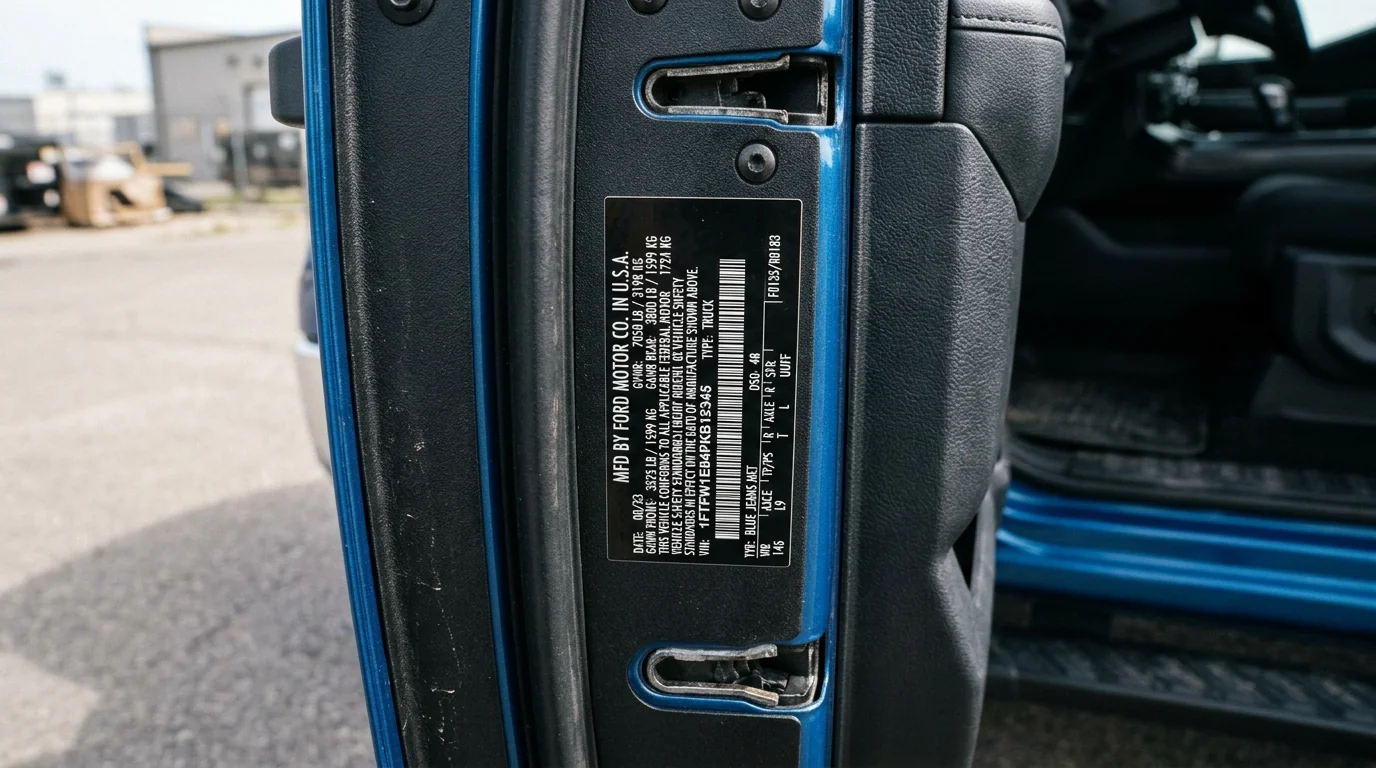
Open the driver’s door and inspect the door edge and surrounding pillar. Depending on the vehicle, you may find a certification label and a separate Tire and Loading Information placard. Photograph them so you can read the small print without repeatedly returning to the truck.
The certification label commonly identifies GVWR, meaning gross vehicle weight rating, and front and rear GAWR, meaning gross axle weight ratings. These establish limits for the whole vehicle and its individual axles.
The loading placard may state the maximum combined weight of occupants and cargo. That is the vehicle’s labeled payload capacity. It describes carrying allowance, not the weight of the pickup itself.
For example, a hypothetical label showing a 7,400 lb GVWR and a 1,650 lb occupant-and-cargo allowance is giving you two different instructions. Neither number is a recent scale reading.
Also look for supplemental labels that address alterations or a reduction in load capacity. If the truck has a service body, conversion, or other substantial changes, consult the applicable upfitter information rather than relying on a generic pickup specification.
Can I Find the Weight of My Truck by VIN?
A vehicle identification number, or VIN, helps identify the vehicle and retrieve relevant factory information. A truck weight by VIN search is useful for narrowing the configuration, but a decoded VIN does not measure the truck.
The US National Highway Traffic Safety Administration offers a public VIN decoder based on manufacturer data. Depending on the record, decoded information may help confirm the vehicle’s identity and specification details. Treat a listed weight class or rating as exactly that, rather than assuming it is empty truck weight.
For a more specific inquiry, contact the manufacturer or a dealer with the VIN and ask:
- Is an original build record or configuration record available?
- Which published truck curb weight applies to this configuration?
- Does that figure include optional factory equipment?
- Are there separate records for a completed commercial body or conversion?
A lookup cannot account for the tools in your bed, a replacement flatbed, or equipment installed years after delivery. Use it to establish the truck’s original identity and a starting specification. Use weighing to establish its present condition.
Match the Specification to the Whole Truck
Searching only the model name often produces a broad range. A short-bed regular-cab pickup and a long-bed crew-cab version can share a badge while having different bodies and equipment.
Before accepting a published figure, match these details:
| Detail to verify | Why it matters |
|---|---|
| Model year and generation | A redesign can change construction and equipment |
| Cab style and bed length | Different body dimensions change the configuration |
| Engine and fuel type | Powertrain assemblies differ |
| Two-wheel or four-wheel drive | Driveline hardware can differ |
| Single or dual rear wheels | Wheels, tires, and related components differ |
| Trim and factory packages | Optional equipment may be excluded from base figures |
Read footnotes beneath specification tables. “Base,” “minimum,” and “as equipped” describe different levels of detail. A minimum figure is a poor substitute for a heavily optioned truck’s actual mass.
Be especially careful with chassis-cab records. A weight for the chassis before installation of a utility body does not describe the completed work truck. Ask the body installer what its documentation covers, including permanently fitted tanks, lifts, or storage systems.
Avoid choosing the midpoint of a published range merely because it looks reasonable. Without knowing which configuration produced either endpoint, that average has no dependable connection to your vehicle.
Estimate an Empty Baseline When You Cannot Weigh Yet
Sometimes you need a provisional number before a scale visit. One possible cross-check is to subtract the labeled occupant-and-cargo allowance from GVWR, provided both figures use the same manufacturer-defined vehicle basis.
Using the fictional labels above:
7,400 lb − 1,650 lb = 5,750 lb
This estimates the baseline implied by those labels. It is not a certified measurement, and alterations or labeling adjustments may prevent it from matching the current truck. Check the manufacturer’s explanation before treating the result as a curb specification.
Next, build a short equipment inventory. Separate items already included in that baseline from equipment added later. Count only the net change when a component replaces another one. Installing a 180 lb bumper in place of a 70 lb bumper adds 110 lb, not 180 lb.
For removable items, a suitable smaller scale may help with an estimate. For assemblies that cannot be weighed safely or accurately in isolation, use documented specifications and mark them as estimates.
An inventory is most useful for spotting forgotten additions, not creating an illusion of exactness. If several entries are guesses, keep the resulting total provisional and confirm it before making a decision close to a loading limit.
Plan a Scale Visit Around the Question You Need Answered
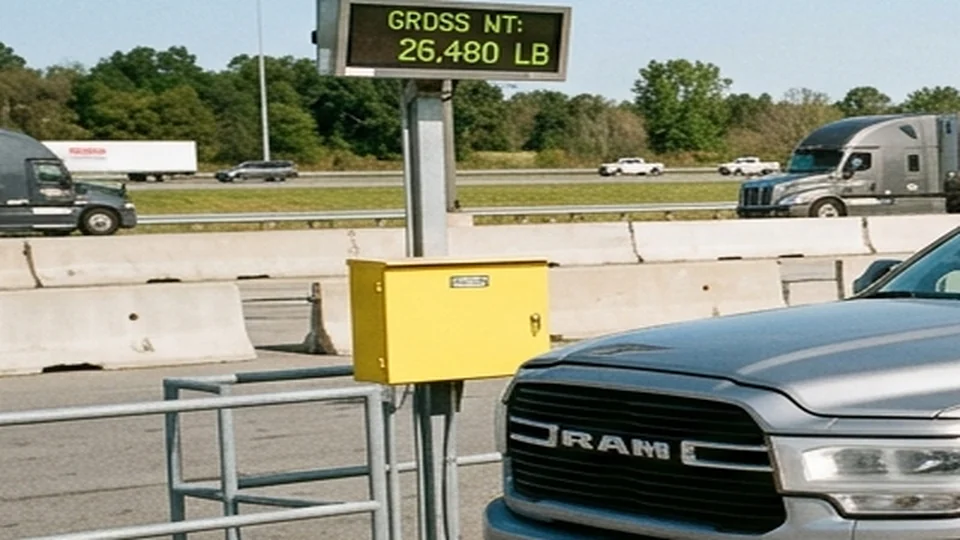
For a direct answer to “how much does my truck weigh,” arrange access to a certified truck scale or another suitable public vehicle scale. Confirm that the facility accepts private pickups and can provide the readings you need.
Explain whether you want a total weight, separate axle weights, or a formal weight certificate. Ask about access, payment, positioning, and any required vehicle details before arriving. A nearby weighbridge may offer only a total reading, which is useful but less detailed than an axle breakdown.
Prepare the truck for the purpose of the visit. To document its usual work condition, bring the equipment normally carried. To check a planned trip, reproduce that passenger and cargo load as closely as possible. Record the fuel level and anything deliberately left out.
At the facility, follow the operator’s directions for platform placement and occupant position. Tell the operator you need front and rear axle readings where available. Keep the vehicle fully supported by the scale as instructed, and remain still while the reading is taken.
CAT Scale explains that its platforms can report axle and total weights, but not individual wheel or corner weights. Do not improvise a one-side-off-platform measurement.
Read the Scale Ticket Beyond the Total
A truck scale ticket may use “steer” for the front axle and “drive” for the rear axle or axle group. Ask the operator to explain unfamiliar labels, especially if you are weighing a pickup at a facility primarily serving commercial vehicles.
Consider this invented two-axle pickup example, weighed without a trailer:
| Reading | Measured load |
|---|---|
| Front axle | 3,100 lb |
| Rear axle | 2,700 lb |
| Total truck weight | 5,800 lb |
The addition checks out: 3,100 + 2,700 = 5,800 lb. Now suppose its labels specify 7,200 lb GVWR, 3,600 lb front GAWR, and 3,800 lb rear GAWR.
The respective margins are 1,400 lb overall, 500 lb at the front, and 1,100 lb at the rear. These margins cannot be added together to create extra carrying capacity. Each limit must be respected independently.
For instance, a later reading of 3,100 lb front and 3,900 lb rear totals only 7,000 lb. That total is below GVWR, yet the rear axle exceeds its hypothetical rating by 100 lb.
Cargo position affects how load reaches the axles. Therefore, subtracting gross vehicle weight from GVWR does not automatically tell you how much can be placed at any particular spot in the bed. Wheel, tire, hitch, and other applicable limits still matter.
Keep the ticket with a note identifying who and what was aboard. If the driver was included in the reading, do not add that person’s weight again when working from the ticket.
Weighing With a Trailer Requires Separate Records
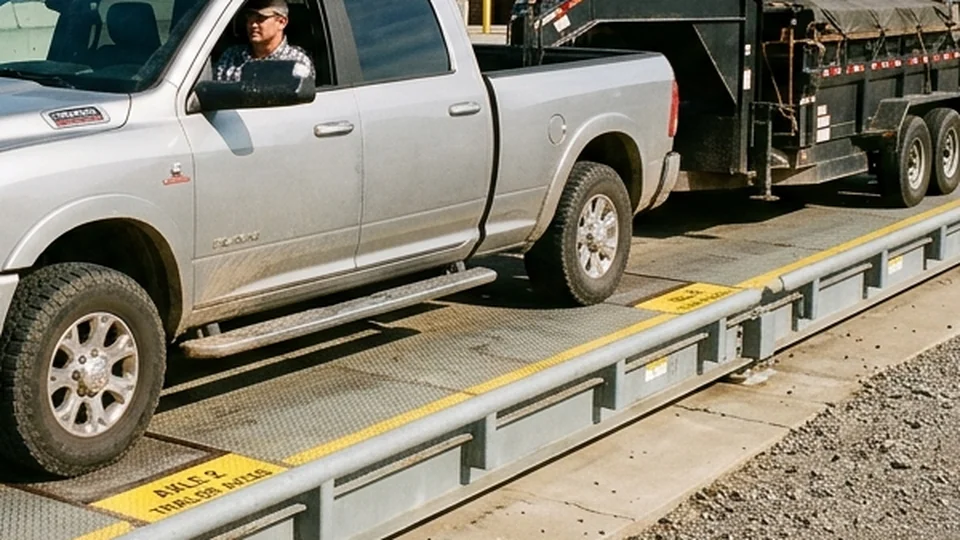
A connected trailer changes the loads supported by the truck’s axles. A scale ticket for the combination therefore answers a different question from a ticket for the truck alone.
For a towing assessment, distinguish three things: loads supported by the truck’s axles, loads supported by the trailer’s axles, and the combined total. Trailer axle readings alone do not represent the trailer’s entire weight because some load is supported through the hitch.
If you also need the truck’s standalone weight, arrange a separate truck-only measurement under comparable conditions. Keep people, fuel, cargo, and hitch hardware consistent, and document anything removed between passes.
A weight-distributing hitch can shift load among the truck and trailer axles. That means a simple change in one axle reading should not automatically be labeled tongue weight. Use the vehicle and hitch manufacturers’ weighing and adjustment procedures, with assistance when needed.
Do not disconnect a trailer on an active scale unless the facility specifically authorizes it. Arrange any uncoupling in the location the operator approves. For this task, accurate records and proper positioning matter more than trying to complete everything in one pass.
Investigate a Mismatch Between Paperwork and the Scale
A result above the published specification does not immediately mean the scale is wrong. First examine what each number includes.
The equipment list is a good place to start. Bed caps, auxiliary tanks, recovery gear, spare parts, and permanent storage can be easy to overlook because they feel like part of the truck. Compare the actual configuration with the source’s stated configuration, then check people and removable cargo.
Next, inspect the paperwork itself. Confirm that you copied a weight rather than a rating, used the right unit, and read the correct line of a specification table. For a scale ticket, verify that the total does not include a trailer you intended to exclude.
If a discrepancy remains unexplained, ask the scale operator about a reweigh and the displayed increments. A rounded reading should not be treated as an exact value to the nearest pound.
Preserve the original ticket and add explanatory notes separately. For later visits, repeat the same setup where possible. Consistent records make a real equipment change easier to distinguish from differences in fuel, cargo, or occupants.
Truck Weight Questions Owners Ask
Does “half-ton truck” mean it weighs 1,000 pounds?
No. “Half-ton” is a conventional pickup category name, not a scale measurement. It also does not reliably state the payload allowance of a modern individual truck. Use the vehicle’s own loading information to assess carrying capacity and a suitable scale to establish what it weighs in its current condition.
Can a registration document tell me the actual weight?
A registration record may list a weight, but the field’s meaning depends on the jurisdiction and document. It might refer to an unladen value, a declared weight, or a registration category. Read the field description or ask the issuing authority before using it. Such paperwork does not measure changes made since the recorded value was established.
Will a bathroom scale work for weighing my pickup?
No. A household scale is unsuitable for vehicle loads and positioning. Use equipment designed for vehicle weighing. If you need individual wheel loads, contact a provider with an appropriate wheel-weighing system and procedure. A regular platform reading divided by four would only be an arithmetic average, not evidence that each wheel supports the same load.
Do I need to empty the fuel tank first?
No. Choose a practical fuel condition that fits the reason for weighing and record it. Draining fuel solely to obtain a number is unnecessary. If you are trying to compare against a published specification, check its fuel assumption. For trip planning, the intended operating load is usually the more useful condition to reproduce.
How often should I weigh the truck again?
Reweigh when changes make the previous ticket a poor description of the vehicle. A new camper, service body, permanent equipment installation, or substantially different load can justify another visit. Keep earlier tickets for comparison, but do not assume a reading from an empty weekend trip represents the same truck loaded for work months later.
Can suspension helpers increase the labeled weight rating?
Do not assume that springs, airbags, or similar accessories raise GVWR or GAWR. Changing how the truck sits does not itself establish a new certified loading limit. Follow the vehicle manufacturer’s ratings and any applicable documented modification approval. Weighing helps identify the supported loads, but it does not change the vehicle’s ratings.
Leave With a Number You Can Explain
The most useful answer to “what is the weight of my truck?” includes the loading condition and the evidence behind it. Keep the truck’s label photos, configuration details, and scale ticket together. Once you know what was measured, you can use that reading for the intended calculation or loading check without confusing it with a factory estimate or a maximum rating.
To pick up a draggable item, press the space bar. While dragging, use the arrow keys to move the item. Press space again to drop the item in its new position, or press escape to cancel.
To pick up a draggable item, press the space bar. While dragging, use the arrow keys to move the item. Press space again to drop the item in its new position, or press escape to cancel.